Pages

Monday, March 14, 2016

March 13, 2016 – Singapore

We arrived in Singapore on Friday morning (March 11), for one of our extended-stay ports. We had three full days to explore one of the most exciting, safe, and forward-thinking cities on the planet. We’ll try to squeeze into this one posting all that we did in our three days here.

Singapore is an island city-state, located just off the southern tip of the Malay Peninsula. It sits 85 miles north of the equator. As such, it has a very warm (some would say hot) climate year-round. Singapore is both the name of the country and of its capital city. There is one main island and sixty other much smaller islets within its territorial waters. The main island (also named Singapore) is only 250 square miles in size – about half the size of New York City. With its 5.5 million residents, Singapore is the second most densely populated nation in the world.

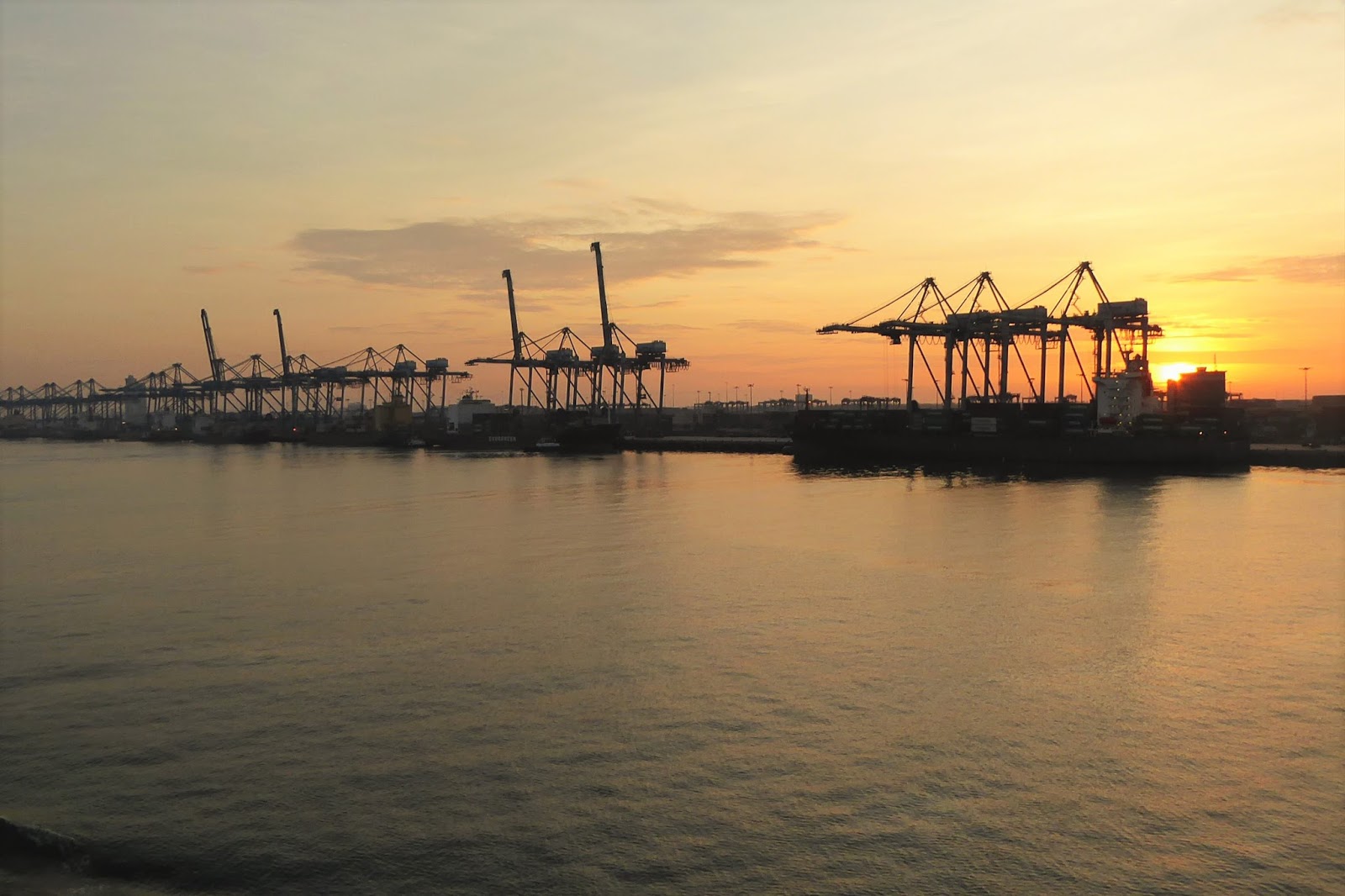
Singapore was founded as a British trading colony in the early 1800s. In 1954, Singapore declared itself a self-governing state. For a short period in the 1960’s, Singapore was a part of the Federation of Malaysia. Since its total independence from Malaysia in 1965, it has become one of the world’s most prosperous countries and boasts one of the world’ largest cargo ports.

Singapore Day 1

We have a big event planned for later today, so we decided to take it easy and save up our strength for tonight.

The ship is docked at HarbourFront Cruise Terminal which includes a large 3-story shopping mall and is adjacent to VivoCity Mall, the largest mall in Singapore. This is not one of our favorite places to dock. Each visitor is required by the Singapore government to carry their own passport (along with embarkation and disembarkation cards) at all times while ashore. The local Customs & Immigration people at HarbourFront are very strict about checking passports carefully every time we get on or off the ship. Additionally, It’s also a long walk from ship to the terminal, including two locations to show passports – about 20 minutes in all to do this, if there are no lines at customs & immigration.

We decided to concentrate on the local area in the early part of the day. We ran the gauntlet through the terminal and passport control successfully and wandered around both of the adjacent shopping malls. At the VivoCity branch of the Tang Department Store (one of the oldest and most popular Singapore stores), Ginny fell for a collection of very interesting and colorful painted elephant ceramic pieces. It turned out that they were part of “Elephant Parade,” which is an organization that runs the world’s largest art exhibition of decorated elephant statues. Each Elephant Parade statue is a unique art piece created by artists and celebrities, and are intended to raise awareness for the need of elephant conservation. These original works are, of course, quite valuable. However, limited-edition handcrafted replicas (of several sizes) are created from the exhibition elephants and sold at selected locations worldwide. We understood that their goal is for a high percentage of Elephant Parade profits to be donated to elephant welfare and conservation projects. Despite the tug on our hearts, we did manage not to buy one, since we don’t have enough luggage space to bring these home.

After returning to the ship and resting for a short time, we went out through another long walk to the terminal through passport control again. Crystal was putting on a special off-ship event for full World Cruise participants, similar to the one they staged in Hawaii back on January 30th (6 weeks ago). This one was being held on Sentosa Island, a popular location visited by some twenty million people a year. Sentosa Island is a single location for many things – a casino, a branch of Universal Studios theme park, numerous clubs, hotels, restaurants, and a white sand beach, just for starters. As a point of interest: The view from our cabin balcony in Singapore is of Sentosa Island, and a cable car system linking Sentosa Island to Singapore Island passes right over the top of our ship while we’re docked here. Anyway, one of the many attractions on Sentosa Island is the very large S.E.A. Aquarium (the SEA stands for South East Asia).

Crystal rented the entire aquarium for exclusive use by the 350 full world cruise travelers this evening. We were greeted by Kompang dancers in costumes and as many Singapore Sling drinks as we could handle. Most of us opted for either wine or soft drinks instead. Then it was through a glass tube in the shark tank to view the exhibits. The claim is that this aquarium complex is home to more than 100,000 marine animals of over 800 species, living in 49 different habitats. Here are photos of some that we particularly enjoyed viewing:


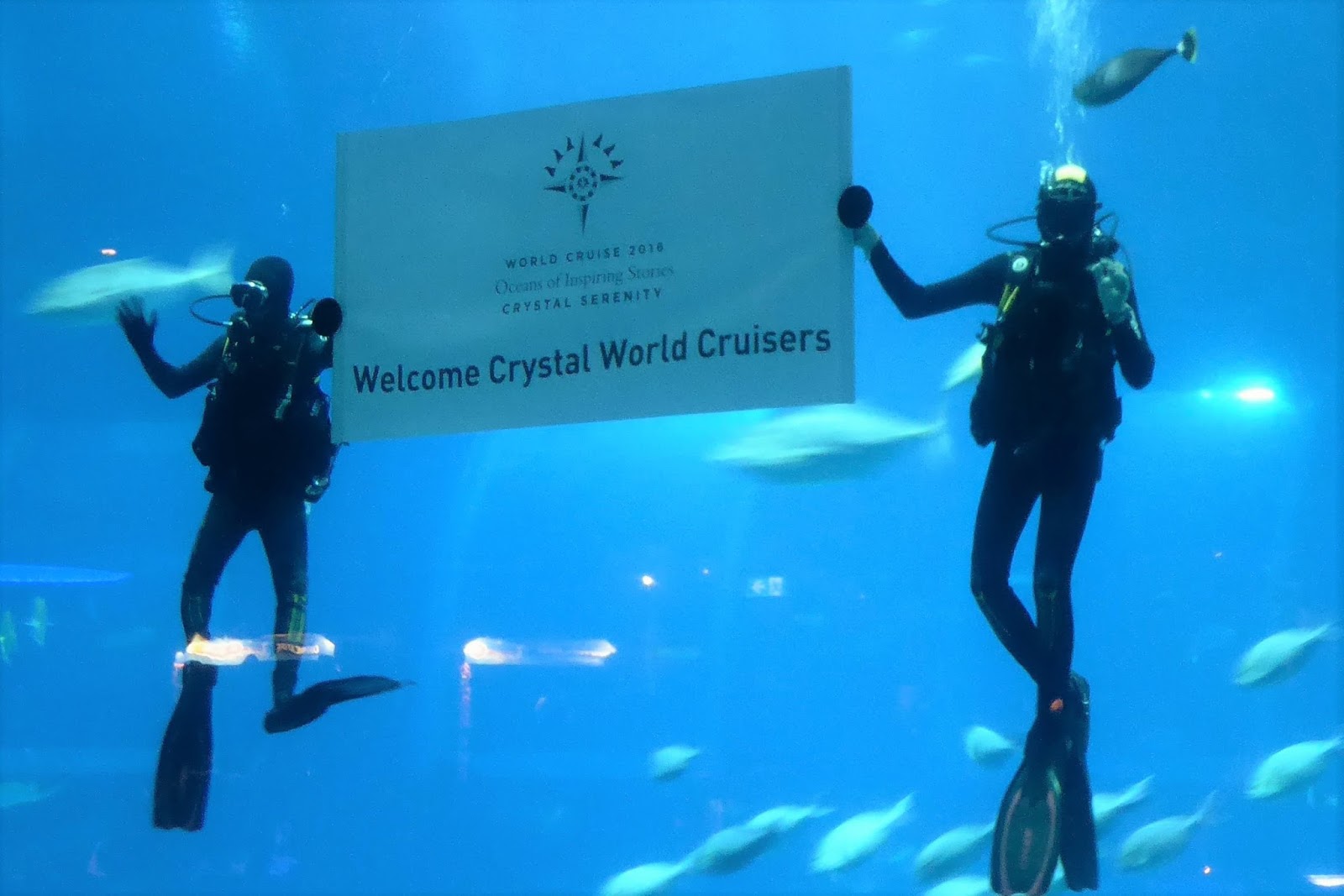
We wound up in the Ocean Gallery, a huge room, with more than 300 of us sitting in front of a gigantic tank, viewing an extraordinary number of large fish, while a harpist performed soothing background music (followed later by a combo of musicians). Several different types of “culinary canapes” (appetizers) from five famous world-class chefs were offered for sampling by roving waiters. We greatly appreciated the effort (and expense) that was put into this special event, and we enjoyed the evening.


Singapore Day 2

Early the next day, Saturday (March 12), we hopped on the Hop-On-Hop-Off (HOHO) Bus at the cruise terminal for a tour all over Singapore. This city has definitely grown to the forefront of the world’s economy in the past 50 years. Everything we saw seems to be modern, well-organized, clean, and efficient. We rode by some remaining colonial-era buildings that are still functioning in new roles after refurbishment, and more modern, tall skyscrapers than it’s possible to count. Also, we admired Orchard Road, a 1.4-mile stretch of the most impressive, high-class shopping districts we’ve ever seen. When we were here three years ago, we did an organized ship’s excursion (which we enjoyed), but today we saw a much larger view of the city, with many choices of where to stop and look around.


We hopped off the HOHO bus at the world-famous and historic Raffles Hotel which first opened for business back in 1887. This grand hotel still brings to mind the days when Singapore was an outpost of the British Empire. As luck would have it, there in the Raffles Gift Shop was a small 10 cm (4 inch) replica of the Raffles Elephant contribution to Elephant Parade. We couldn’t pass this up, as it seemed like it was pre-destined that we have one of these elephants. We peeked in at the Long Bar – one of the most popular tourist attractions in Singapore – but didn’t purchase one of the famous Singapore Sling drinks (first served in 1915 at this hotel), which now cost close to $30 per serving.


After returning to the ship after this excellent adventure, we had a good lunch on board and then Jim wanted to do more sightseeing, so he set off at about 2:00 pm for the MRT (subway) station. His goal was to explore the Marina Bay area, including futuristic Gardens by the Bay and the Marina Bay Sands Hotel. It’s an experience in itself just to ride on the MRT (which stands for Mass Rapid Transit). it’s spotlessly clean – no trash, no graffiti – and all the signage in the stations and on the train are well thought-out to benefit the traveler (including tourists). As there is an MRT stop right in the HarbourFront Cruise Center, it was easy to buy tickets and hop on the subway right there. You can buy individual tickets (using cash only) for each ride on the subway via easy-to-use automated kiosks. But what Jim actually did was go to the Ticket Office (in the station) and buy a 1-day Tourist Pass for $10 (plus a refundable deposit of $10).

Once reaching the Bayfront subway stop, Jim walked off the train and followed excellent signs to the Gardens by the Bay park via a lengthy underground tunnel and then a shuttle tram. Gardens by the Bay opened within the last five years and is a 21st Century botanic garden marvel – a 250-acre park with plant life from around the world and high-tech “super trees”, “bio domes”, and themed Heritage Garden areas.


Admission to the Gardens is free, but there is a S$28 fee to enter the two conservatories (“bio domes”). As Jim was short on time, he decided to skip the bio domes. As he understood it, within the Flower Dome are plants that grow in drier Mediterranean and sub-tropical climate zones. The Cloud Forest recreates a cool mountain forest of the tropics, including a 100-foot man-made mountain and waterfall. We imagine that the two domes could take an hour each to explore.

“Super trees” are major attractions – tall constructions made of steel and concrete modeled after giant mammoth trees that are illuminated at night. The 18 “super trees” are up to 160-feet tall. They have a distinctive look with metal trunks and branches, with plants and flowers growing along the sides of the trees. Connecting some of the “super trees” is an aerial walkway (called Skyway), 70-feet above the ground. Jim paid the small fee and went up the elevator in one of the trees. From there, he walked between the trees, with great views of the trees, gardens, city, and South China Sea. Unfortunately, Jim couldn’t stay there waiting for the sun to set, to see the light display from within the branches of the trees. We’re sure that the show is well worth seeing, as we’ve seen pictures of it, but Jim decided he needed to get back on the ship (and not miss dinner).


Adjacent to the Gardens by the Bay is the Marina Bay Sands Hotel, which consists of three very tall towers, with a 787-foot rooftop platform and swimming pool terrace spanning across all three buildings (called Sands SkyPark). From a distance SkyPark resembles a very long canoe. Jim walked through the building after touring the gardens, but didn’t pay the non-hotel-guest fee (somewhere around $20) to take the elevator up to look at SkyPark.


From the hotel, Jim hopped back on the MRT, returned to the HarbourFront station, and walked through the terminal back to the ship in time for dinner. It was a long, but rewarding, day.

Singapore Day 3
Our good friends from Oregon, Gary & Joyce, were in town on vacation. They’re going to board the MS Volendam in Singapore a few days from now. We traveled with them three years ago on Holland America’s Around the World cruise, and we’ve stayed in touch ever since. So we invited them to join us on board the Serenity at 8:15 for breakfast and a tour of our favorite hangouts on the ship. Gary & Joyce have visited Singapore many times, and they had a plan to go two places today – first the Jurong Bird Park and then the Chinese Garden. They invited us to join them, and Jim decided to go with them, while Ginny decided to stay on the ship and do some reading.


The biggest downside to travel today was the long and time-consuming trek through the terminal. There was another ship in port (a Star Line gambling ship, we thought) that decided to unload all their passengers at the same time we were leaving the Serenity. The line at Customs & Integration was enormous (think JFK airport Customs & Integration if five Jumbo Jets all arrived at the same exact time). The two preceding days there was a special line for Crystal passengers – we were essentially using the ship as a hotel coming & going for the three days in port – but not today. It took more than 1½ hours to get to the terminal from our ship. We understand and appreciate the need for security, but this was ridiculous.

When we finally reached the terminal, we went to the MRT station and bought tickets using the ticket machine and set off for the Jurong Bird Park. We made a transfer at one station and then caught a bus for the last link. The park itself is advertised as “Asia’s largest bird paradise,” and it is large. Spread across 50 acres, they have 5,000 birds from 400 species that, for the most part, roam freely in natural habitats. Especially nice were several large free-flight aviaries where visitors (that was us) walk through a door into a net and screen covered enclosure, so the birds can’t escape or fly away. The Waterfall Aviary – including a 100-foot tall waterfall feature is “the world’s largest walk-in aviary with over 600 free-flying birds.”


About the time we reached the halfway point walking around the park, Jim was getting nervous about making it back to the ship in time before it left for Thailand, so he had to leave Gary & Joyce and head for the exit. When Jim reached the exit of the park it started to rain, and it looked like it might start coming down even harder. He didn’t look forward to waiting for the bus in the rain, so his decision was to take a taxi back to the cruise port. That was a good idea, because it started to pour down rain for the rest of the drive (and it continued for hours after that). The rest of the story went just as well, as the Star Line ship had already left the port, and there was no backup in the passport line. He returned to the ship with plenty of time to spare.

It’s too bad Jim didn’t get to see the entire park, but what he did see was very nice. He especially enjoyed the Waterfall Aviary, the Indoor Penguin Exhibit (home to about 100 penguins across five species), and the very nicely landscaped tropical settings. If you’re interested in birds, this is the place to come – probably one of the best in the world. It was especially nice to be able to share time with Gary & Joyce, and we wish them well on their upcoming voyage.

Some final thoughts: Singapore seems to be a modern, vibrant, wealthy city-state, with a healthy respect for the past including their Chinese, Malay, and Indian heritages. It is said that Singapore has the best quality of life in Asia and, indeed, one of the best in the world. We certainly have no reason to doubt that, based on our three-day visit. It seems to be doing everything right.

The one downside is going ashore from a cruise ship at the HarbourFront terminal -- the lengthy walk from our ship to the terminal and the time-consuming, frustrating, security and passport checking. This is not an easy or pleasant experience, but I can't really fault them too strongly for a high concern over security.

Tonight Crystal Serenity departs from Singapore and cruises up the east coast of the Malaysian Peninsula for two port calls in Thailand.

Jim & Ginny

Thursday, March 10, 2016

March 09, 2016 – Penang & Langkawi, Malaysia

We bid farewell to Port Kelong and Kuala Lumpur on Monday afternoon, March 7, and headed north in the Strait of Malacca – along the west coast of Malaysia. We visited two islands on Tuesday and Wednesday, both of which are popular destinations for international holiday travelers.

Penang, Malaysia (March 8, 2016)

The British East Indies Company established a colony on Penang Island in 1786. As such, it is the oldest British settlement in Malaysia. They brought in Chinese and Indian laborers to work in the rubber and tin businesses. Today there is a mixture of cultures on the island. Penang became part of the independent nation of Malaysia in 1957.

The ship was docked at George Town, the largest city on the island, and the capital of Penang state. Today, the population of Penang is 1.5 million, and it is rather urbanized and industrialized. However, downtown George Town itself still retains a good bit of its British heritage, and it has been certified on the UNESCO World Heritage list. It was only a short walk from the pier to some of George Town’s attractions.


We drove through the city on our tour this morning and decided not walk back onto town after returning to the ship. Most of the beaches and international resort hotels are located more than an hour away, by taxi, from George Town.

We decided to take it easy today, and signed up for a shore excursion titled, “Penang Light & Easy.” It was a short tour, only 3½ hours long. Our first stop was at Wat Chaiya Mangalaram, a Thai Buddhist temple in George Town. This temple is home of the fourth largest reclining Buddha in the world. Being a Thai temple, the exterior was very colorful, with smaller shrines of different Buddhas and other Thai mythical creatures and deities. Our tour guide Proteen walked us around the interior of the temple (after we took off our shoes). She told us that the reclining Buddha is 108 feet long and is made of gold leaf, while the white of the eyes and the toenails are composed completely of Mother-of-Pearl.


Across the street from the Thai Buddhist Temple is the Dhammikarama Burmese Buddhist Temple, which is a place of retreat for Buddhist devotees with Burmese heritage. As the pictures below will attest, the Thai and Burmese architectural temple styles are very different. Proteen gave us free time to wander this temple on our own. 


Next was a visit to the Penang Botanic Gardens – which was first established by the British in 1884. Jim walked around the park for about 45 minutes. Proteen warned us to not bring any food with us, if we decided to walk, because the monkeys might attack. Jim followed those directions and didn’t see any monkeys. Almost all the trees in this large (74 acre) garden were identified with markers, but many of them were unfamiliar to most of us.

Our last stop was for a drink at the Eastern & Oriental Hotel, which was built in 1885 by the Sarkies brothers, who later went on to build the world-famous Raffles Hotel in Singapore. When it was built, this hotel was called "The Premier Hotel East of Suez.” It’s now a historical downtown property and not located close to a beach resort. We did, however, admire views of the beach hotels from along the hotel’s seafront location. 


Langkawi, Malaysia (March 9, 2016)

It was a fairly short overnight cruise to Langkawi, which is a grouping of about 100 islands in a strategic location at the northern end of the Strait of Malacca where the Strait meets the Andaman Sea. To be more precise we are18 miles off the west coast of northern Malaysia and five miles from Thailand. Pulau Langkawi, where we’re docked, is the largest of these islands, with a population of approximately 95,000 residents. Kuah is the largest town on the island, but our docking location (Porto Malai) is located about 10 miles from Kuah. Once again, this is an island with a large number of outstanding tourist hotels and beaches, which are located at the northern tip of the island. That didn’t really appeal to us, especially the very long taxi drive as we were at the extreme southern end of the island.

The port was bare bones – a long cement pier – and there were no shops or other facilities. However, a shuttle bus was provided for passengers to go to and from the nearest small town. Serenity was safely docked at 8:00am, right in the middle of a partial solar eclipse (more on that later).

There were very pleasant views of this beautiful island from our ship. We can understand why it’s such a favorite tourist spot.


When we were last here in 2013, we greatly enjoyed a gondola ride up to the summit of Machingang Mountain (2,300 feet). The gondola went up the mountain at a 42º incline. When we reached the top we had great views. This is one of the major attractions in Langkawi, and we’d recommend it to anyone. However, we decided we didn’t need to do that again. So we chose to catch the shuttle bus into the closest small “town,” which was the location of some duty-free shops and Underwater World

We took the shuttle bus at about 9:40 am and rode through some construction zones. Apparently developers plan to start building more resort hotels in this southern part of the island. Once we reached the duty-free shops, we wandered around a little bit, but found nothing of interest to us, other than a refrigerator magnet and a Ritter Sport candy bar. We did walk down to a beach area (we believe it was called Pantai Cenang Beach). This beach seemed to be mostly for local people. As with the other locations we visited in Malaysia, there is a mix of races and ethnicities here. We read that, once again, Muslim and Chinese seemed to have the largest percentage.


Underwater World looked fairly nice, but we’re going to a big aquarium in Singapore. So we skipped it and headed back to the ship after about an hour in “town.” 

Life on board Crystal Serenity is still very good. We’ve gone to the three specialty restaurants (Prego, Silk Road, and Tastes) at least once over the past week. On March 4, we were invited for cocktails at the Captains Quarters adjacent to the Navigation Bridge. There was a group of about 20 of us that attended. We assume that everyone on the World Cruise gets at least one invitation.

We tend to attend most of the evening entertainment in either the Galaxy Lounge or Stardust Café. They are normally scheduled for 8:30 pm and 10:30 pm. Since we eat dinner at the main seating (6:00 pm), we always go to the 8:30 show. Those who eat dinner at Late Seating (8:30 pm) go to the 10:30 show, although sometimes there is a 7:00 pm show for them. Several of the shows that were especially good were Steve Stevens (comedian & musical entertainer) and a special show developed for the World Cruise by the entertainment team – “Radio Hour – A Sentimental Journey.” A part of this show also included The Spinettes, a trio of young, vintage-inspired performers from London who sing hits from the 1940s, 1950s, and 1960s. They were very talented, and everyone seemed to love them. They returned several days later for their own show in the Stardust Café accompanied, of course, by the The Galaxy Orchestra.

Through the first three segments of the World Cruise, there have been three different magicians, from the Magic Castle in Hollywood. They perform 30-minute shows in the Pulse nightclub. The audience is restricted to 20 people maximum, and tickets are hard to get. We’ve been lucky enough to see all three of them, and they’ve been amazing.

This morning, March 9th, there was a partial eclipse of the sun, visible here in Malaysia. There is an astronomer on board ship for this segment of the cruise. We were told that, if we wanted to see the eclipse, we should go up to the 13th deck between 7:30 and 9:30 am. W
e went up at 8:30, and it was really happening! They gave each of us a pair of “Eclipse Shades,” which are safe for direct solar viewing. When we put on the shades all we could see was the sun, and the moon was hiding about 40% of the sun. Without the shades, it wasn’t apparent that anything special was happening. We tried to take a picture, but it didn’t turn out. However, our friend Karen did successfully capture it, as shown below.


We have one sea day on our way south in the Strait of Malacca. We're scheduled to arrive in Singapore on Friday morning, March 11 at 8:00 am. We’ll spend three full days here, departing Sunday, March 13 at 6:00 pm.

Jim & Ginny

Wednesday, March 9, 2016

March 07, 2016 – Kuala Lumpur, Malaysia Day 2

After a good night’s sleep overnight in Kuala Lumpur, we awoke to another beautiful, but hot, day. Jim joined a fairly small group of 13 passengers on an 8-hour shore excursion called “Heritage Walk through Kuala Lumpur“ and it turned out to be a great day. There was an excellent mix of history and a lot of the modern – actually a good juxtaposition of present-day Kuala Lumpur.

We were lucky enough to have a very good walking guide named Tony, who is a 63-year old retired man of Chinese heritage. During the nearly 1½-hour drive into the city, he told us honestly what life is like in Kuala Lumpur. He is very, very happy and proud of all that has happened here within his lifetime.

The initial two-and-a-half hour guided walk began at Merdeka (Independence) Square, which is situated in the heart of Kuala Lumpur. Tony described the day – August 31, 1957 – when the Union Jack was lowered for the final time and the Malayan flag was hoisted for the first time. Ever since then, this very large square has been the site for civic events. The square is surrounded by both historical and modern buildings, all of which Tony described to us as we walked around the green, grassy site.


Two of the highlights are the Royal Selangor Club, the Tudor-style building over Jim’s shoulder in the first photo above (formerly the center of social life, including cricket, during the British colonial period), and the 312-foot tall flagpole which impressively flies the Malayan flag. We even visited underground to look at where the flagpole is anchored. Across the street from the square is the impressive Sultan Abdul Samad building, which was built in the 1890s with a 135-foot clock tower that the British called “Little Ben” because of its resemblance to “Big Ben” in London. The building was used during colonial years to administer the Malayan colonies. These days the building is somewhat overshadowed by modern towers, as shown below.


Next we walked to the Old Market Square and the nearby site where the first Chinese settlers landed at the confluence of the Klang and Gombak rivers in 1857. Tony told us that the name Kuala Lumpur literally means “Muddy Confluence” in the Malay language. We continued to the Sin Sze Si Ya Buddhist Temple, built in 1864. This is the oldest place of worship in Kuala Lumpur. It was small and filled with incense, as it is still an active temple. As a practicing Buddhist, Tony attempted to explain everything to us that we saw, but it didn’t all sink in, as there was a lot going on.


It was then a fairly short walk to the Sri Maha Mariamman Temple which, once again, is the oldest Hindu temple in Kuala Lumpur – built in 1873 as a private shrine for one family but was then opened to the public in the 1920s. We were told that many improvements were made in 1968. The most eye-catching feature is the five-tier tower at the front of the building:


We spent a lot time walking all the way around this large temple, admiring the brightly colored art work. Jim must have taken 30 pictures; here’s a random sample of them:


By this time we were beginning to feel the heat – It had reached 95ºF (with heat index above 100 ºF). But in order to reach the bus for the ride to lunch, we walked through Petaling Street, the major street in Chinatown. which has been pedestrianized and covered with a green roof. There were people selling almost anything you might want to buy. Tony said most things here are “genuine imitations” of branded merchandise. We finally reached the bus and drove to the so-called “Golden Triangle” – Kuala Lumpur’s very modern and busy business center. Lunch was at the Saloma Theatre Restaurant in a very large room, obviously set up for tour groups. It was actually a good buffet of Malaysian and western choices.

After lunch, we went by motor coach to visit the Petronas Twin Towers (also known as Petronas Towers KLCC). The towers have become a symbol for Kuala Lumpur, known throughout the world and a great source of pride for the city. At a height of 1,400 feet, they were the tallest buildings in the world from 1999 until 2004, when the Taipei 101 building opened in Taipei. City officials still claim that they are the tallest twin towers in the world. A unique feature is the double-deck “Skybridge” between the twin buildings on the 41st and 42nd floors, which is about 558 feet above ground – claimed to be the highest 2-story bridge in the world. There is also an observation deck on the 86th floor. About 75% of the complex is occupied by Petronas, the national oil company of Malaysia.


Tony took us on a walk through the center section, attached between the two buildings. This section contains a 6-story luxury shopping mall (Suria KLCC), dozens of restaurants, a performance hall – home for the Malaysian Philharmonic Orchestra – an underwater aquarium and also a Science center. Suria KLCC is one of the largest shopping malls in Malaysia.

On the back side of the buildings is a 17-acre green rolling park, with jogging and walking trails, a fountain with an incorporated light show, a children’s pool, and a good site for photos of the towers. Naturally, we covered that area thoroughly also.

Last on our wonderful tour was a visit to the KL Tower – a 1,381-foot tall communications and broadcasting tower. We went up one of four elevators to the observation deck and marveled at the spectacular views of the extraordinary number of skyscrapers in this city.


Everyone enjoys something different on a guided tour, but Jim’s highlight definitely included the visits to KL Tower and the Petronas Towers. If you look at the picture of the Sultan Abdul Samad building (at Independence Square) shown earlier in this posting, you can see these modern engineering marvels looming in the background.

There is no slowing down on this part of the world cruise. For the next two days, we’ll remain in Malaysia with visits to Penang and Langkawi.

Jim & Ginny

Monday, March 7, 2016

March 06, 2016 – Kuala Lumpur, Malaysia

Wow – we were very impressed with Kuala Lumpur the two days we’ve been here. The city has grown and developed into a major metropolis rapidly over the past 45 years since Jim visited here (in 1971). It’s now a big, modern and well-planned world-class city.
We docked at Port Kelong, an enormous, busy cargo port. The port has a modern passenger terminal with a few shopping options and free Wi-Fi. Unfortunately, it’s about a 1-hour drive from the port to downtown Kuala Lumpur. But that didn’t stop us from taking advantage of our time here.


The first day in port (March 6) we signed up for a 5-hour shore excursion titled, “A Glimpse of Kuala Lumpur.” The second day, Jim set off with a small group on an 8-hour “Heritage Walk through Kuala Lumpur.” We’ll review the first day in this posting and then cover Jim’s walking excursion in the next posting.

Of course, two hours of the excursions each day were spent on a motor coach “commuting” into the city from the port and then returning. Luckily we had very modern and comfortable coaches both days and, once out of the port, the “coach commander” (as he was called) drives along excellent toll road highways.

As we approached the city, we saw many brand new high-rise apartment and condo buildings – in some cases, entire villages of these buildings. There are actually two types of new high-rise buildings, according to one of our guides. Some are government buildings for low income families. These are smaller apartments, without balconies. Privately built buildings have apartments ranging from medium size to extreme luxury units. Our tour guides told us that many of the groups of these high-rise buildings have their own stores and markets, to encourage people to not drive into the city for shopping. There are also free bus services into the city to encourage people to commute using public transportation.

Some introductory material: Kuala Lumpur is the Capital city of Malaysia. However, with all the modern growth in the city, most government administration buildings have moved out of town and are now located in Putrajaya, 20 miles outside of the city. We found that the Kuala Lumpur region has a population of approximately 7.2 million. This includes 1.7 million living in the core city of Kuala Lumpur and 5.5 million in the suburbs (which includes Putrajaya). On working days, the number of people in the city (including commuters) is 3 million. Our tour guides told us that the population of the entire country of Malaysia is now 31 million.

As you probably know, Malaysia is located on the Malay Peninsula, with Thailand to the north and the city of Singapore at the southern end of the peninsula. To the west of the peninsula is the Strait of Malacca, which separates the Malay Peninsula from the large island of Sumatra (Indonesia). The Strait of Malacca is one of the busiest shipping lanes in the world, connecting the Andaman Sea of the Indian Ocean (at the north end) with the South China Sea of the Pacific Ocean (at the south end).

We were amazed with the number of ships we saw as we cruised through the Strait on our way north to Kuala Lumpur -- at one point we counted more than 60 ships on just our starboard side of the Serenity. This is the shortest sea route between three of the world’s most populous countries – India, China, and Indonesia. We were told that 50,000 vessels transit the Strait every year. About 25% of the world’s sea cargo (including 50% of the oil shipped around the world by sea) goes through the Strait of Malacca.

Getting back to Malaysia – It is an ethnically, racially, and culturally diverse nation. There are three main groups of people: Malay (44%), Chinese (43%), and Indian (10%). The primary religion is Muslim, but all religions are allowed. We were told that the Malaysian people in Kuala Lumpur celebrate all religious holidays together. Colonizers originally came here to be tin miners in the 1850s, and then later to establish rubber plantations. Our tour guides said that now they are most proud of their auto production (Proton cars), petroleum, and palm oil products.

Malaysia obtained their independence from Great Britain in 1957. They are still a member of the British Commonwealth. There’s been strong growth, especially since the early 1990s. We saw an extraordinary number of tall skyscrapers, luxury hotels, and giant shopping centers. Building cranes are working on new growth all over the city.

Highlights of some of the sites we visited today included the National Monument -- a 50-foot tall bronze sculpture paying tribute to soldiers who gave their lives during the two world wars and those who died defending their country during the communist insurgency (in the 1950s). The same artist created this monument and the Iwo Jima Monument in Washington, D.C.


Next was the National Mosque (Masjid Negara), which was built in the historic center of the city in the mid-1960s, but it looks quite modern. We were told that this mosque is Southeast Asia’s largest, can hold 15,000 worshipers, and has a minaret that rises to a height of 240 feet. It’s “dome” has the appearance of a partially opened umbrella. We did not go inside the building (maybe because we didn’t have time to do that).


Next to the National Mosque is the Old Railway Station and the National Railway Headquarters buildings, which were completed in 1910 and 1917 respectively, across the street from each other. Both have a mixture of impressive Moorish and Gothic architectural elements. A newer, modern Central Station has taken over most of the functions of the old station, although it is now only a stop for commuter trains.


At the center of the Colonial District downtown is Merdeka (Independence) Square, which is the site where the Malay nation hoisted their own flag in August 1957, celebrating their independence from British rule. A very tall flagpole (close to 312 feet high) is at one end of the square. At the other end is a large open, grassy field which was used by the British colonial powers as a cricket field. The Royal Selangor Club, a Tudor-style structure still remains. Across the street is the impressive Sultan Abdul Samad Building, with its copper domes. We’ll write more about Merdeka Square in our next posting.
Tonight, a local group of performers were invited on board ship to present a cultural show in the Galaxy Lounge featuring traditional Malaysian dances and costumes. Especially noteworthy were the colorful costumes. All of us greatly enjoyed the show.
More tomorrow about Kuala Lumpur (including photos of the more modern parts of the city), along with some of the events that have taken place on board Serenity recently.
Jim & Ginny


Friday, March 4, 2016

March 03, 2016 – Semarang, Indonesia

Semarang is one of those big cities where cruise ships dock along with container ships, warehouses, and other cargo ships in a busy, noisy industrial area. However, they seemed to be happy to see us, as a small musical group and many dancers were along the dock to greet the ship. They started playing at 7:00 am when we pulled into port, but it took quite a while before local officials cleared passengers to leave the ship. By the time we walked down the gangway after 9:00, the dancers and band had all quit playing and left the area. Maybe it got too hot for them, as it definitely was a hot, humid day. We found out more about the humidity later in the day.


Many of Serenity’s passengers opted for one of three different tours being offered by the Shore Excursion Office to visit Borobuder, a World Heritage Site in the province of Jogyakarta. The tours varied from 9 hours to 10½ hours in length; all of these included six hours driving time (round-trip). Borobuder is the most visited attraction in Indonesia, and is the world’s largest and best preserved ancient Buddhist temple, dating from the 9th century AD. Jim had visited Borobuder back in 1970, and we decided to forego the long bus ride. Those passengers we know that did one of the Borobuder trips said it was worth the drive.

We signed up for a ship’s excursion called “Javanese Culture & Traditions” which turned out to be a good choice for us. Semarang is a large and industrialized city (about 2 million residents) on the north coast of the island of Java. As we said in a previous blog posting, about 145 million people live on the island of Java (claimed to be the most heavily populated island in the world). The Indonesian capital city, Jakarta, is located on western Java. Semarang is the capital city of Central Java, one three provinces on the island. Central Java has 31 million residents.

There were three buses set up for our group from the Serenity on the Culture & Traditions trip. The tour guide on our bus, named Iqbal, did a very good job explaining the city’s interesting history, spanning periods of rule by the Chinese, Dutch, and Japanese. As a result, Semarang has many temples and churches of various religions, including Buddhist, Hindu, Islam, and Christian. He said that, even though Islam is the predominant religion in Indonesia, there is no dictate from the government about which religion people should follow. He said that the Islamic traditions in Java came from China and are not as strict as those in the Middle East. Women don’t wear scarfs, and there’s no need to stop work and pray multiple times per day.

We had a police escort for our three tour buses, so we were preceded by flashing lights and a blaring siren wherever we drove today. This was a perfect way to stay on schedule and not get bogged down by traffic. The police cleared the path for us -- sometimes driving on the wrong side of the road, while cutting off and stopping long lines of traffic, and making quite a ruckus. We’d like to have a police escort like that back home!

Our first stop was the Blenduk Church – the oldest Christian church in Central Java, dating back to 1753. The church is in the “Old City” and was built by the Dutch in a unique square shape with a large dome. It was intended to look like a mosque but still have Christian features. At one time it had a large pipe organ, but that doesn’t operate any more. Iqbal said that, historically, not many Javanese people converted to Christianity during the period of Dutch rule, because the Dutch were their “enemies.”


We stopped at a large Buddhist temple complex called Buddhagaya Watugong. The most prominent feature here is the Avalokitesvara Pagoda – a striking 7-level white tower trimmed in colors of red, green, and gold. At a height of 148 feet, we understand that this pagoda is the tallest in Indonesia. 


Jim climbed up the long, broad stairway to see the golden statue of Buddha on the first level. He then walked over to a second building, called the Dharmasala which housed a “meditation” room. Again there was a golden Buddha statue. Iqbal described the significance of some of the trees planted on the grounds here – especially the Bodhi tree and the Sala tree, both of which were significant during the life of Buddha.


Our final stop was at the Balemong Resort hotel which is very attractive and consisted of many different buildings, nestled within a tropical garden setting. We passed through a warm, wood-paneled reception building to an outdoor area where we enjoyed a warm welcome drink that we were told contained cinnamon, cloves, lemongrass, and some other herbs. A light rain started while we walked a fairly long distance outdoors to a stand-alone demonstration room for preparing batik fabric. After a short demonstration, we each tried to use an old pen-like device in a bamboo holder to put hot wax along a pre-printed flower design on a piece of fabric. This was a lot more difficult than we thought it would be.


While we were learning how to become batik artisans, the skies opened up and very heavy rain started pouring down. After finishing our batik efforts, we were supposed to walk to the restaurant building for lunch. We waited for a while, because we thought the “monsoon” rain would just be a shower and would end soon. Unfortunately, it didn’t stop at all, and several inches of rain were flooding the grounds. Eventually the hotel staff drove three vans along a long back pathway to our building, picked us up, and drove us to the restaurant building. Getting into and out of the van wasn’t easy, and we got soaking wet.


Lunch was a buffet of rice and Indonesian specialties. After lunch, Iqbal told us that we should go back to the batik building to see a demonstration of rice field plowing by water buffalo; umbrellas were available to use. We and about 10 others decided that we didn’t need to walk that far in the monsoon rain to see a water buffalo, so we walked (with umbrellas) to the reception building where the buses were parked. After only about 15 minutes, the rest of the group arrived at the buses, and we were ready to leave. Balemong Resort was a very nice facility and they had a good plan for us, but Mother Nature took charge today.

On the ride back to the harbor, Iqbal gave us the final products of our batik efforts. The hotel staff had died the fabric for us. We don’t think anyone in our group will be returning to Java to take a job in the batik industry. The rain gradually tapered off, and by the time we got back to the ship it had stopped. The good news is that the people who had traveled all the way to Borobudur and back didn’t see any rain at all.

Following our return to Crystal Serenity and dinner in the dining room, we attended a concert by Tom Ward in the Stardust Café. The only possible word to describe his performance is “amazing.” He is an incredibly accomplished classical guitarist. We don’t know how he can possibly move his hands so fast and produce such complex music.

After our three stops in Indonesia, we’re now headed for Malaysia. After crossing the equator northbound, we will be in port four consecutive days in Malaysia -- two days at Port Kelang (closest seaport for Kuala Lumpur) March 6 & 7 --  followed by Penang and Langkawi on March 8 & 9.

Jim & Ginny


Thursday, March 3, 2016

March 1, 2016 – Bali, Indonesia

We arrived at the port of Benoa, on the island of Bali February 28 in early afternoon (instead of the earlier published time of 9:00 am). We were told there is a strong current in the port area during high tide, and the ship must be turned dramatically once inside the port, so it’s better to do this maneuver during low tide when the current isn’t as strong. At least this is what we understood the situation to be. Arrival time change had been announced to all passengers some time ago, so changes for shore excursions and all other arrangements had been handled efficiently before we arrived.

As we cruised into port we watched (from our balcony) lots of activities at the resort beaches – especially parasailing, jet-skiing, and something we hadn’t seen before that we read is called a “flying fish ride.” It looks like a rubber raft being towed by a speedboat. It eventually becomes airborne. Using his binoculars, Jim thought he saw three people in these rafts – two tourists lying flat in the raft (and trembling, we’re sure), while a third person was standing up and steering the raft while in the air.

The cruise terminal at Benoa is small, with only a one-person tourist information center offering maps of the island, along with one small souvenir stand, and a money-changing booth. For our arrival, a small musical group was performing the unique Indonesian “gong” music. A few other costumed people greeted us as we walked off the ship.


From this location, on a peninsula at the southernmost tip of Bali Island, choices for visiting attractions on Bali are limited to ship excursions or all-day taxi rentals. Due to local restrictions, Crystal could not set up shuttle service to the nearest town center which is about six miles away. Outside the terminal’s gate there are many taxi drivers and some of our passengers struck off on their own with these drivers. We heard mostly good reports from those who contracted with the taxi drivers for these personal tours.

When you think about Indonesia, you must consider the enormous number of people living in this country. There are 17,500 islands which comprise Indonesia (only 6,000 of which are inhabited), and Bali is not among the top five of these islands in size. We read that the population of Indonesia is now close to 250 million. Of that number, roughly 58% (145 million) live on the one single island of Java, where we will be visiting later this week. The island of Bali lies just two miles east of Java, across the Bali Strait. Bali’s population is also growing rapidly. On the small island of Bali (95 mi x 69 mi), population is now 4.2 million, not even counting the 5 million international tourists who visit here every year on holiday.

The first night in port, a local group was invited on board Crystal Serenity to perform a Balinese Cultural Show in the Galaxy Lounge, featuring the traditional Kecak Dance. This “dance” (also called the Monkey Dance) is unlike anything we’ve seen anywhere else in the world. On stage were about 40 black-and-white-saronged men who accompanied the dance by swaying in unison and chanting sounds (something like “chak-a-chak” and other rhythmic sounds of the forest for 45 minutes. The men almost seemed lilke they were in a trance. Meanwhile, highly costumed actors were interpreting a mythological Balinese folktale of good triumphing over evil.

We were here on Bali just three years ago, and we visited some of the highlights then – through the mountains, rice fields, a water palace, and lunch at a nice resort. This year we decided to take a shore excursion titled, “Balinese Arts & Crafts Discovery.” By driving through the central valley north of Benoa in the general direction of the center of the island, we passed through many villages which specialized in various art forms. Apparently these are family traditions passed down through the generations; but each village had many families working in the same medium. We started in the village of Celuk, which is known for gold and silver crafts. Then we went to the village of Kemenuh for a tour of a very large woodworking center, where we bought a wooden Balinese-style mask. Then to Lodtunduh for watercolor artwork and to Tohpati for unique batik products.


Actually, one of the highlights of the day was our first stop, where we witnessed a private performance, at an outdoor temple, of a traditional Barong Play in five acts. It was explained that the play and accompanying dance represent the eternal fight between good and evil. The story line and characters were similar to (but not exactly the same as) the Kecak Dance performed on board Crystal Serenity the first night in port. Main characters were the Barong, which is a mythological animal (looking like a combination of a Lion and a Dog) representing a good spirit, and Rangda (a mythological monster) representing an evil spirit.


There were many other costumed characters, including a monkey, a tiger, a witch, two girl-dancers, and other random characters going on and off stage. The dance and play were accompanied by a band playing Gamelan music, which could more realistically be called “gong” music. Their instruments are metal plates laid on top of bamboo tubes. The players strike the plates with hammers. Accompanying this sound are drums and cymbals. We’ve seen these unique Balinese plays before, but this one was especially well done, with beautiful costumes and fabrics.


Visiting Bali is a unique experience. The most interesting part of the trip, for us, was riding through villages off the main highways. Within these villages, almost every home had a religious stonework shrine (to honor their family’s ancestors) at the entrance to their home. The people place daily offerings of flowers or fruit on the shrine. There was also a large Hindu temple in each village. As you probably know, the nation of Indonesia has more Muslims than any other country in the world (88% of the total Indonesian population). However, Bali is a big exception, with 90% of people on Bali adhering to what they call Balinese Hinduism. This faith evidently forms the foundation for their everyday lives.


One other colorful feature we saw was the large number of Umbul Poles at many homes and stores. They are traditional tall poles made from bamboo, coconuts, and flowers; some of the more modern poles contained silk banners. These were installed for a New Year’s celebration period of three weeks. As we understood it, they are intended to help bring prosperity in the new year.

Bali is a land where myths and legends are passed from one generation to the next. Artistic crafts and culture seem to still be important to the people of Bali. Family is especially important to them. Outside developers have bought and over-developed many internationally popular generic beach resorts within the past 20 years. Where we were docked, there were large airplanes taking off and landing at the busy airport every three minutes during large parts of the day. The tourist business is booming! If you visit and want to find the “real Bali,” you must escape from these resort areas, which have brought traffic jams, Starbucks and McDonalds outlets in the southern part of the island. The beautiful mountain and jungle scenery, volcanoes, and genuinely friendly Balinese people are still there.

Bali was the end of Segment 2 of the 
6-segment World Cruise. An equal number of passengers embarked and disembarked here (about 300 of each, we understand), and new enrichment lecturers for Segment 3 replaced those from Segment 2. This segment is also described as “Crystal Wine & Food Festival theme cruise.” A guest chef is on board and will hold hands-on cooking classes (for winners of a raffle). He will also hold public cooking demonstrations and hand out recipe cards. Ginny is sure to attend these demonstrations. There will be a “Guest Spice Expert” presenting seminars. We also anticipate special dinners, lunch buffets, wine-tasting seminars, along with special tea time events.

It turns out that one of the guests on board Serenity, Barry Shulman, is a world-famous poker player, having won well over $5 million playing poker. He’s been the winner of two World Series of Poker championships, including the gold championship bracelets. He agreed to provide an afternoon lecture for fellow guests on his poker experience, which we attended. I don’t think we learned any of his secrets, but it was interesting to hear what it’s like at these major televised poker tournaments.

We’re both still healthy and enjoying our vacation. Next report will be from Semarang, Indonesia.

Jim & Ginny