Pages

Saturday, March 19, 2016

March 17, 2016 – Sihanoukville, Cambodia

We weren’t sure what we would encounter at this stop, especially wondering how much of the country has recovered from what has been characterized as the genocidal brutality of Pol Pot’s Khmer Rouge back in the late 1970’s.

Sihanoukville is a port city on the Gulf of Thailand in southern Cambodia. The city was built in the early 1960s as the first deep-water port for the country. The area boomed for a while, but when the reigning monarch of Cambodia, Norodom Sihanouk, was deposed in 1970, the country fell into chaos. The Khmer Rouge seized control of the country and installed a regime led by Pol Pot. Reports that we’ve read claim that the Khmer Rouge exterminated somewhere between one and a half to three million of Cambodia’s most accomplished citizens, and many others died of starvation, disease or overwork. Exact numbers are apparently hard to determine. According to what we’ve read, the Khmer Rouge was attempting to return Cambodia to an agrarian socialist society. Apparently at least 20,000 mass graves, known as the “Killing Fields,” have been uncovered. Vietnam launched a full-scale invasion of Cambodia in 1978 and subsequently removed the Khmer Rouge government from power. However, military and political skirmishes between the Khmer Rouge and Vietnam continued until a peace treaty was signed in 1991.

Enough of the history lesson. For our visit today we signed up for a ship’s excursion titled, “Panoramic Sihanoukville.” Others on the ship elected to travel all the way to the nation’s capital in Phnom Penh (a 12-hour excursion) or to the Killing Fields themselves (also a 12-hour trip). Both these excursions involved eight hours riding in buses. We were told that the Killing Fields tour and visit to the Genocide Museum would “contain graphic content that may be unsettling to some guests.” We didn’t think we were ready for that.

There were four busloads of Serenity passengers who signed up for the Panoramic tour. We waited in the Stardust Club to be called, then went down to the buses. We were lucky to get on the bus that we did. It was an old coach, but at least the air conditioner worked. Others were not so lucky.

Our first stop was at Wat Krom, a Buddhist temple as well as living and school facilities for monks, including residence rooms and a dining hall, along with stupas and statues. Some 90% of Cambodian people are Buddhist. This small complex was built in 1963 but suffered the same fate as many other religious sites during the regime of Pol Pot, with the monks being required to leave while the temples and other structures were destroyed. The local people are working slowly to rebuild. Today, new young monks have returned, and daily rituals have been re-instated. There were many interesting statues and a graveyard with small stupa towers. We couldn’t go in some of the buildings, because monks were eating meals or doing other of their daily rituals.


Leaving Wat Krom, the tour took us to Kamping Chas village for a short visit to a farmer’s house. This was a very basic structure – small and Spartan – in an area that looks like at one time it was lived in by fairly well-to-do people. There were walls and fences separating what appeared to be dozens of separate home plots that were now totally overgrown with weeds; we assumed that these might have been remnants of Khmer Rouge actions in the 1970s, and the homeowners never returned. We have no way to know that, but we did see these same situations in the Sihanoukville area where we traveled.


Next stop was at the Kamping Chas Primary School to observe the children’s school activities. This was actually a fairly nice facility, with five large classrooms. Our local guide, Paum, told us that the children go to school four hours per day, either in the morning or in the afternoon. There was a sign on the school grounds that read, “Donated by American Navy.” We didn’t know to what that sign was referring – the sliding board, the fence, or the entire classroom building. In fact, we didn’t know why the American Navy would have donated anything to this single school. Anyway, the kids all wore clean uniforms and were very cute, with big smiles. In the school’s office we saw about 15 fairly large boxes that had apparently just been delivered to the school. We were told that the donations came from Crystal Serenity. We hadn’t heard anything about this on the ship, but it certainly was nice to know that Crystal had donated this much to the school.


The driver then took us to the P’sa Leu Market in the center of Sihanoukville, and we were given 30 minutes to explore the displays of fish, poultry, and fruits at the market. Paum told us there are 1,500 stalls set up in a 2½ acre space. All four of our tour buses pulled into the parking lot at the same. We decided to stay on the air conditioned bus instead. Over the years, we’ve seen plenty of local fresh food markets around the world, they’re all very similar, and we never buy anything.

Finally, we came to the Sokha Beach Resort, for a scheduled 1 hour and 20 minute visit. The hotel had some tents set up with refreshments (one drink per person – soda, water, or juice). We ordered a soda and sat down by the water to relax. Others took off their shoes, rolled up their pants legs and waded into the water. Even more people walked to the hotel building to use the restrooms. After about 30 minutes of watching the waves at the beach, we walked up to the hotel. Unfortunately, the power went off right then, and there were no lights or windows in the restrooms. So we walked back up the beach and waited for the buses to pick us up again.


This country survived a horrific experience in the recent past, and came out of it with a lot of scars. Once outside of the center city of Sihanoukville, we saw a lot of poverty. Of all the up-and-coming Asian countries, this one stands out as still facing economic difficulties. We can’t solve that, but at least we did visit and we wish them well.

To top off this day in Cambodia, a local cultural dance team came on board Serenity and demonstrated some of their traditional dances. Most impressive were their costumes and the way they could bend their wrists seemingly in an impossible pose. We didn't take any photos tonight at the show; you will just have to believe us.

A new group of enrichment speakers boarded the ship, and we attended several of their lectures. First was General Hugh Shelton, who has a very broad background in the U.S. Army and was Chairman of the Joint Chiefs of Staff from 1997 retiring in 2001. Also very interesting was Ron Marks, a former spy for the CIA. Each of the speakers holds three or four sessions while they’re on the ship, usually on sea days. Jon Courtenay made a second appearance in the Galaxy Lounge, with a new show – more piano & more comedy. Opening his show was a performance by Crystal’s phenomenal dance duo, Curtis & Beverly. They are known for their incredible lifts.

Now we have one day at sea, before arriving in Vietnam on Saturday, March 19.

Jim and Ginny


Friday, March 18, 2016

March 16, 2016 – Bangkok, Thailand

Wow – there have been a lot of changes in Bangkok since Jim last visited here in 1970. Back then there were 3 million people living in the city and now there are 12 million, according to our tour guide, Liu. It’s a good example of “You can’t go home again.” Jim remembered it as a slow-moving, beautiful, happy place, with many canals intersecting throughout the city. Now many of those canals have been filled in with concrete to create roads for automobiles. Nonetheless, roads were choked with traffic today, and air pollution was heavy. The Thai people in Bangkok seem to have remained friendly, always smiling, and the ancient temples and palaces are still shiny and remarkable – although the skyline now has many high-rise buildings and skyscraper towers, to handle the huge population increase.

Crystal Serenity arrived at the very busy and enormous container port of Laem Chabang at 6:00 this morning. Our travel agent had arranged for a private guide and driver for us in Bangkok, through Signature Travel. We met them outside the terminal at 7:00 am and left immediately for the city. Unfortunately, it took 2 hours, 15 minutes to get there, even though we were on major highways the entire way. It wasn’t a pretty drive – smoggy and very industrialized most of the way, as we shared the road with hundreds of trucks into town. Of course, Bangkok is the capital and most populous city of Thailand, so there is a lot to see.

We started our tour at the Grand Palace, one of the most famous attractions in all of Thailand. As such, it was uncomfortably over-crowded (approaching mob-scene status) with numerous tour groups, many apparently from China. As we understand it, construction of this complex of buildings was started in 1782 by King Rama I and it was expanded and improved upon by subsequent rulers. It was the king’s official residence until 1946. Our walking tour of the Grand Palace grounds took several hours and included the Throne Hall, the Coronation Hall, the Reception Palace and the Funeral Palace.


Of special interest within the Grand Palace was the Emerald Buddha at the Wat Phra Kaew temple. The Emerald Buddha is a dark green statue, only 26 inches tall, carved from a single jade stone. We understand that “emerald" in the Thai language indicates the deep green color and not the specific emerald stone. Except for the Thai King and the Crown Prince, no one is allowed to touch the statue. The King personally changes the Buddha’s golden cloak three times a year, once for each of the seasons – summer, winter, and rainy season. Within the Grand Palace, there were many “proper clothing” restrictions for us to follow and, of course, it’s necessary to take off shoes to go into any of the temples. Photography is not permitted inside any of the temples.


After fighting the crowds within the Grand Palace, it was pleasant to visit Wat Pho, another Buddhist temple complex within a very short drive from the Palace. Wat Pho is most famous for the Temple of the Reclining Buddha (or Phra Buiddhasaiyas), a statue covered in gold leaf that is 150 feet long and stands 50 feet high. We were told that Thai and foreign Buddhists believe that worshiping this statue brings them peace and happiness. Indoor photos of the Reclining Buddha were allowed. Just an interesting note: Wat Pho is also considered the first center of public education in Thailand and reputedly the birthplace of traditional Thai massage. Therefore, the temple is sometimes referred to as “Thailand’s first university,” at least according to Liu (our tour guide).


After these two visits to very large temple complexes, we needed to relax and were driven to the Jim Thompson House and Museum where we enjoyed a nice Thai lunch at their restaurant. After lunch we walked through Jim Thompson’s attractive Thai-style house and garden. Thompson was an American military officer stationed in Bangkok during World War II. After the war, he moved to Bangkok and settled here permanently. Before the war he was a practicing architect, so he designed a complex of six old teak-wood houses that were moved here for his own home. Later, he was the founder of the silk company that bears his name, while helping to revive the local silk industry. Mr. Thompson disappeared in 1967 while on a visit to Malaysia, and his home is now a museum housing his collection of Asian antiques, pottery, and other curiosities. We took the tour and then made a minor purchase at the Jim Thompson Silk Shop, located on the premises.


That was all we had time for, as we had to return to the ship before it departed tonight. Once again, it was close to a 2½-hour drive back to the port. It was an 8-hour day, of which nearly five hours were spent driving to and from the city.

We saw a recent statement: “Time marches inevitably on to the betterment and detriment of all cities. Bangkok is no exception.” For Jim, most of the charm was gone; but, one day (five hours) is not enough time to do justice to a city with this much history and modern attractions. Clearly the best way to see Bangkok is to stay in a nice hotel downtown along the river for a few days and look around at leisure (without the long 4½-hour commute to & from the port every day).


Even though Jim’s birthday is March 17th, we celebrated it today (March 16), because one of the couples at our dining room table (Jerry & Karen) are leaving tomorrow morning from Sihanoukville for a 2-night extended excursion to visit Angkor Wat. Our maître d’ had set up a special dinner at our request – a chateaubriand steak, which was carved into eight pieces at the table, as well as a handmade Caesar Salad (also prepared at the table), and a Key Lime Pie (with birthday candle) for desert. Jim was very grateful for all the special attention.

As a follow-up to the above, in addition to Angkor Wat, there were other extended off-ship excursions offered from Bangkok, including a 3-night overland adventure in Laos, and a 4-night overland adventure to Bhutan (which we think is closer to Nepal and India than to Bangkok). Clearly we didn’t sign up for either of these.

We’re now on our way to Cambodia (Sihanoukville) with arrival scheduled for tomorrow morning (March 17) at 10:00 am.

Jim & Ginny


Thursday, March 17, 2016

March 15, 2016 – Ko Samui, Thailand

Upon leaving Singapore, we completed Segment 3 of the World Cruise and started heading northbound on Segment 4 (Singapore to Shanghai), leaving the Southern Hemisphere behind. This is the halfway point for the 102-day adventure. We were told that 400 new passengers boarded the ship in Singapore, but we don’t know how many disembarked; it must have been a similar number. 

Yesterday evening (Monday, March 14), we went to Prego and shared dinner with our friend Frank Main who is a nearby neighbor at Shell Point in Ft. Myers. We run across him occasionally on the ship but had not had a chance to talk at length until last night. This is Frank’s seventh consecutive World Cruise on this ship, and he has a circle of friends on board that he met on past cruises. He’s been enjoying the cruise and has been getting some sun, as he spends a lot of time exercising in the pool every day.


Today we anchored offshore of Ko Samui, an island off Thailand’s east coast (see the map below). This is Thailand’s second largest island, Phuket (on the west coast) being the largest. We signed up for a shore excursion titled, Ko Samui Kaleidoscope. Ginny has come down with a head cold and didn’t feel up to the tender ride from ship to shore and the 5½-hour tour; so she canceled out. Jim went ashore without her and was very glad he did, as it was a great tour – circling this scenic island on its only paved road and experiencing the rural settings.


Interestingly, there are no buses on the island of Ko Samui. Our excellent guide, Sally, told us that they had been planning for our ship’s visit for the past three months, and the buses we rode today were all shipped here by ferry boat from the mainland of Thailand for our use. There are many beach resorts on this island, as Ko Samui is fast-becoming a playground for the youthful set. However, these visitors don’t take bus tours, as beaches are the big draw for these people. Sally told us that the population of Ko Samui is 50,000, but they have more than 1 million international visitors per year.

Here are some more interesting facts from our guide: 80% of the people are Buddhist; there are two seasons – hot and very hot (they dream of visiting the U.S. in winter and touching snow); family pets on the island are monkeys and water buffalos. Their local attitude is “never mind.” For example, there are five traffic signals on the island, but none of them work. The favorite form of transportation is motorbikes. With one motorbike, she claims you can carry your whole family. They produce no food on the island (other than coconuts); everything else must be imported. If Ko Samui people want to visit Bangkok, they must first take a ferry boat to the mainland (2 hours). Once there, they can take a train (which is never on time) or it’s a 12-hour drive -- there is air service, but it’s too expensive for them

The Kaleidoscope tour began by riding to an elephant show at Island Safari. We were each given a coconut and a straw for our welcome drink. Then the elephants did various tricks, including hula hoops, basketball, and an unusual elephant version of a Thai massage for several of our brave (foolhardy) fellow guests. 


As suggested by our guide, after the show Jim fed his coconut to one of the elephants, who seemed to enjoy crushing it and eating the fruit inside.

After that, we drove to see Wat Phra Yai -- a very large golden Buddha statue located on a small island connected to Ko Samui by a long, dirt causeway. The statue is nicknamed “Big Buddha.” This is a meditation center, not a temple, but we still needed to remove our shoes before climbing the 75 steps to get a closer view of the statue itself and the pretty views from the top. Those who didn’t climb to the top had loads of shopping opportunities at the base of the stairs.


Next on our around-the-island Kaleidoscope tour was a remarkable complex called Wat Plai Laem, which is a living and active temple, where local Buddhists and visitors come daily to pay homage to Guanyin and the Buddha, After we removed our shoes, hats, and sun-glasses, Sally brought us into the prayer room, where she explained how Buddhists pray to the Buddha for guidance.


Outside the temple, within the extensive grounds, were many statues, shrines, and elaborately decorated buildings.

The largest statue is of Guanyin, the goddess of compassion & mercy. This is a towering white structure in Chinese style set in the center of the temple grounds As you can see in the photo, the goddess has 18 arms that fan out from her lap to above her head. Her many arms apparently represent her ability to reach out and provide help across the world. Jim understood that she is also thought of as a fertility goddess; many who come here pray for her help in bearing healthy children.


Also on the grounds is the Fat Chinese Happy Buddha. As Jim understood it, within the Chinese culture, a fat Buddha represents wealth and prosperity. The statue is also very tall, about 100 feet high.


Next on the tour, we rode to the Nora Beach Resort & Spa, a pleasant facility with low-rise buildings made of native woods, perched along the beach. We entered the reception area and walked down a lengthy hill to the beach, passing individual guest bungalows – all of which had picturesque views. One interesting note, they all seemed to have outdoor showers (behind walls, for privacy). We enjoyed an excellent buffet lunch with a large number of Thai or Western options, while we overlooked the swim pool and beach. This is a very nice hotel on the eastern (touristy) side of the island called Chaweng Beach.

Lastly, we greatly enjoyed a short visit to a small coconut plantation to watch a demonstration of how well-trained monkeys are used to collect coconuts for their masters. Ko Samui is known as the Coconut Island, because it’s biggest crop is coconuts. We were told that three million coconuts per month are shipped from Ko Samui to Bangkok. Sally told us that only boy monkeys are used to collect coconuts. Each family on Ko Samui is allowed to own one monkey, which must be registered with the local government. The monkey goes to school for six months to learn how to climb the trees and loosen the coconuts so they fall to the ground.


Ko Samui was a very good port stop. We encountered happy, smiling people, clean and functional villages, popular white sand beaches, and colorful, fascinating Buddhist temples.

The good life continues aboard Crystal Serenity. Nightly entertainment has been wonderful. Especially good was Jon Courtenay – an excellent pianist with a unique comedy style. We really enjoyed his show, with great songs and almost nonstop laughter. Appearing on a different night were the MacDonald Brothers – musicians from Scotland who played contemporary songs as well as Scottish standards. We have seen these brothers perform aboard ship in the past.

Of course, every night there’s informal venues with music all over the ship. The Astoria Strings Quartet and Glenn Amer (piano) alternate appearances throughout the night, from 5:15 pm to Midnight. In the Palm Court, the Crystal Sextet plays for dancing from 5:15 pm until 12:30 am. In the Avenue Saloon, Steve Doyle plays piano and sings from 7:45 pm – 8:30 pm and 9:30 pm – 1:00 am. In the Pulse Nightclub, there’s Karaoke from 10:00 pm – Midnight and a DJ spinning the latest hits from Midnight until “late.” At the Hollywood Theater, there are movies generally at 8:00 pm and 10:30 pm. When not in port, the casino operates until 2:00 am. That gives us lots of choices, but we’re almost always in bed and asleep by 10:00 pm.

Jim & Ginny


Monday, March 14, 2016

March 13, 2016 – Singapore

We arrived in Singapore on Friday morning (March 11), for one of our extended-stay ports. We had three full days to explore one of the most exciting, safe, and forward-thinking cities on the planet. We’ll try to squeeze into this one posting all that we did in our three days here.

Singapore is an island city-state, located just off the southern tip of the Malay Peninsula. It sits 85 miles north of the equator. As such, it has a very warm (some would say hot) climate year-round. Singapore is both the name of the country and of its capital city. There is one main island and sixty other much smaller islets within its territorial waters. The main island (also named Singapore) is only 250 square miles in size – about half the size of New York City. With its 5.5 million residents, Singapore is the second most densely populated nation in the world.

Singapore was founded as a British trading colony in the early 1800s. In 1954, Singapore declared itself a self-governing state. For a short period in the 1960’s, Singapore was a part of the Federation of Malaysia. Since its total independence from Malaysia in 1965, it has become one of the world’s most prosperous countries and boasts one of the world’ largest cargo ports.

Singapore Day 1

We have a big event planned for later today, so we decided to take it easy and save up our strength for tonight.

The ship is docked at HarbourFront Cruise Terminal which includes a large 3-story shopping mall and is adjacent to VivoCity Mall, the largest mall in Singapore. This is not one of our favorite places to dock. Each visitor is required by the Singapore government to carry their own passport (along with embarkation and disembarkation cards) at all times while ashore. The local Customs & Immigration people at HarbourFront are very strict about checking passports carefully every time we get on or off the ship. Additionally, It’s also a long walk from ship to the terminal, including two locations to show passports – about 20 minutes in all to do this, if there are no lines at customs & immigration.

We decided to concentrate on the local area in the early part of the day. We ran the gauntlet through the terminal and passport control successfully and wandered around both of the adjacent shopping malls. At the VivoCity branch of the Tang Department Store (one of the oldest and most popular Singapore stores), Ginny fell for a collection of very interesting and colorful painted elephant ceramic pieces. It turned out that they were part of “Elephant Parade,” which is an organization that runs the world’s largest art exhibition of decorated elephant statues. Each Elephant Parade statue is a unique art piece created by artists and celebrities, and are intended to raise awareness for the need of elephant conservation. These original works are, of course, quite valuable. However, limited-edition handcrafted replicas (of several sizes) are created from the exhibition elephants and sold at selected locations worldwide. We understood that their goal is for a high percentage of Elephant Parade profits to be donated to elephant welfare and conservation projects. Despite the tug on our hearts, we did manage not to buy one, since we don’t have enough luggage space to bring these home.

After returning to the ship and resting for a short time, we went out through another long walk to the terminal through passport control again. Crystal was putting on a special off-ship event for full World Cruise participants, similar to the one they staged in Hawaii back on January 30th (6 weeks ago). This one was being held on Sentosa Island, a popular location visited by some twenty million people a year. Sentosa Island is a single location for many things – a casino, a branch of Universal Studios theme park, numerous clubs, hotels, restaurants, and a white sand beach, just for starters. As a point of interest: The view from our cabin balcony in Singapore is of Sentosa Island, and a cable car system linking Sentosa Island to Singapore Island passes right over the top of our ship while we’re docked here. Anyway, one of the many attractions on Sentosa Island is the very large S.E.A. Aquarium (the SEA stands for South East Asia).

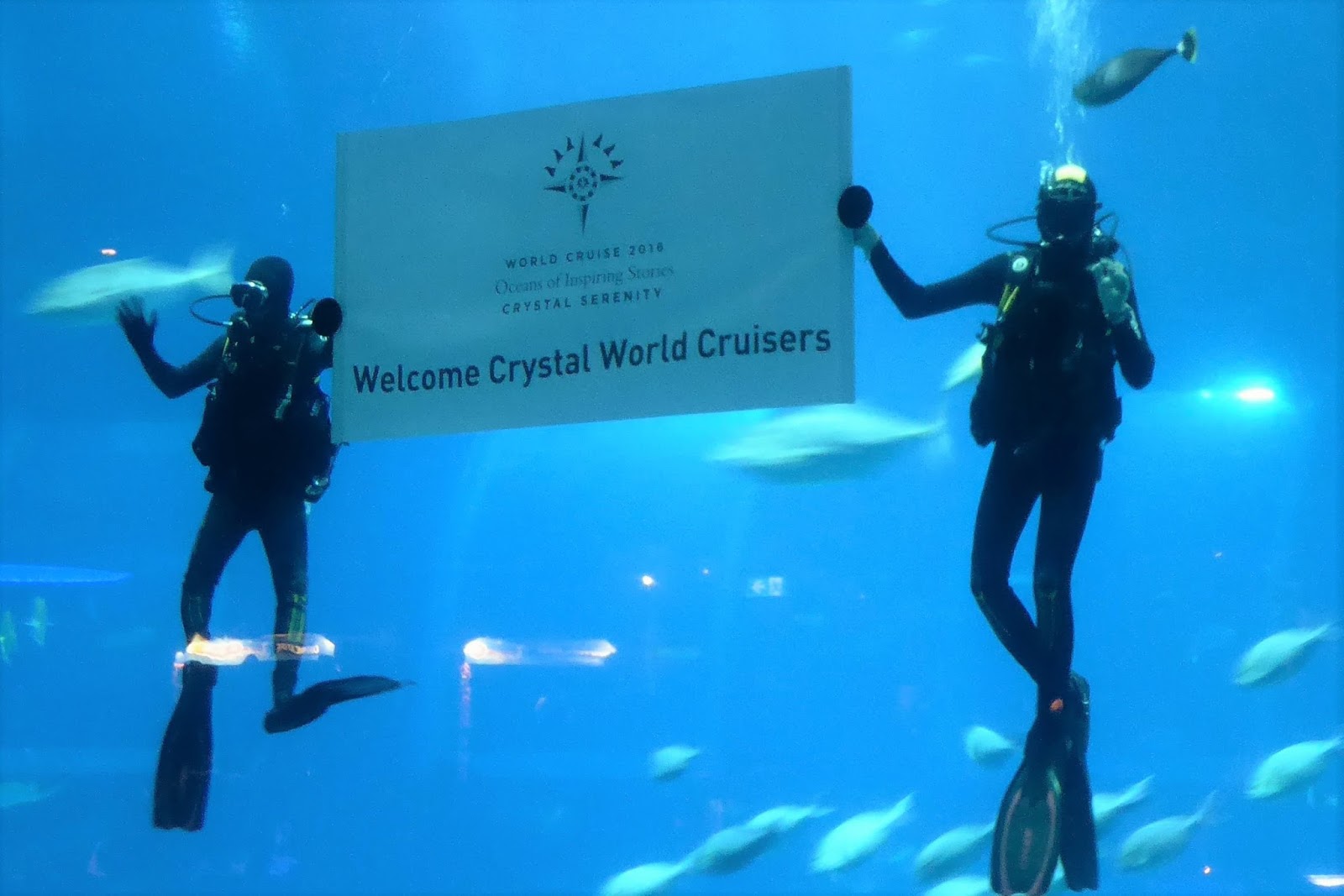
Crystal rented the entire aquarium for exclusive use by the 350 full world cruise travelers this evening. We were greeted by Kompang dancers in costumes and as many Singapore Sling drinks as we could handle. Most of us opted for either wine or soft drinks instead. Then it was through a glass tube in the shark tank to view the exhibits. The claim is that this aquarium complex is home to more than 100,000 marine animals of over 800 species, living in 49 different habitats. Here are photos of some that we particularly enjoyed viewing:


We wound up in the Ocean Gallery, a huge room, with more than 300 of us sitting in front of a gigantic tank, viewing an extraordinary number of large fish, while a harpist performed soothing background music (followed later by a combo of musicians). Several different types of “culinary canapes” (appetizers) from five famous world-class chefs were offered for sampling by roving waiters. We greatly appreciated the effort (and expense) that was put into this special event, and we enjoyed the evening.


Singapore Day 2

Early the next day, Saturday (March 12), we hopped on the Hop-On-Hop-Off (HOHO) Bus at the cruise terminal for a tour all over Singapore. This city has definitely grown to the forefront of the world’s economy in the past 50 years. Everything we saw seems to be modern, well-organized, clean, and efficient. We rode by some remaining colonial-era buildings that are still functioning in new roles after refurbishment, and more modern, tall skyscrapers than it’s possible to count. Also, we admired Orchard Road, a 1.4-mile stretch of the most impressive, high-class shopping districts we’ve ever seen. When we were here three years ago, we did an organized ship’s excursion (which we enjoyed), but today we saw a much larger view of the city, with many choices of where to stop and look around.


We hopped off the HOHO bus at the world-famous and historic Raffles Hotel which first opened for business back in 1887. This grand hotel still brings to mind the days when Singapore was an outpost of the British Empire. As luck would have it, there in the Raffles Gift Shop was a small 10 cm (4 inch) replica of the Raffles Elephant contribution to Elephant Parade. We couldn’t pass this up, as it seemed like it was pre-destined that we have one of these elephants. We peeked in at the Long Bar – one of the most popular tourist attractions in Singapore – but didn’t purchase one of the famous Singapore Sling drinks (first served in 1915 at this hotel), which now cost close to $30 per serving.


After returning to the ship after this excellent adventure, we had a good lunch on board and then Jim wanted to do more sightseeing, so he set off at about 2:00 pm for the MRT (subway) station. His goal was to explore the Marina Bay area, including futuristic Gardens by the Bay and the Marina Bay Sands Hotel. It’s an experience in itself just to ride on the MRT (which stands for Mass Rapid Transit). it’s spotlessly clean – no trash, no graffiti – and all the signage in the stations and on the train are well thought-out to benefit the traveler (including tourists). As there is an MRT stop right in the HarbourFront Cruise Center, it was easy to buy tickets and hop on the subway right there. You can buy individual tickets (using cash only) for each ride on the subway via easy-to-use automated kiosks. But what Jim actually did was go to the Ticket Office (in the station) and buy a 1-day Tourist Pass for $10 (plus a refundable deposit of $10).

Once reaching the Bayfront subway stop, Jim walked off the train and followed excellent signs to the Gardens by the Bay park via a lengthy underground tunnel and then a shuttle tram. Gardens by the Bay opened within the last five years and is a 21st Century botanic garden marvel – a 250-acre park with plant life from around the world and high-tech “super trees”, “bio domes”, and themed Heritage Garden areas.


Admission to the Gardens is free, but there is a S$28 fee to enter the two conservatories (“bio domes”). As Jim was short on time, he decided to skip the bio domes. As he understood it, within the Flower Dome are plants that grow in drier Mediterranean and sub-tropical climate zones. The Cloud Forest recreates a cool mountain forest of the tropics, including a 100-foot man-made mountain and waterfall. We imagine that the two domes could take an hour each to explore.

“Super trees” are major attractions – tall constructions made of steel and concrete modeled after giant mammoth trees that are illuminated at night. The 18 “super trees” are up to 160-feet tall. They have a distinctive look with metal trunks and branches, with plants and flowers growing along the sides of the trees. Connecting some of the “super trees” is an aerial walkway (called Skyway), 70-feet above the ground. Jim paid the small fee and went up the elevator in one of the trees. From there, he walked between the trees, with great views of the trees, gardens, city, and South China Sea. Unfortunately, Jim couldn’t stay there waiting for the sun to set, to see the light display from within the branches of the trees. We’re sure that the show is well worth seeing, as we’ve seen pictures of it, but Jim decided he needed to get back on the ship (and not miss dinner).


Adjacent to the Gardens by the Bay is the Marina Bay Sands Hotel, which consists of three very tall towers, with a 787-foot rooftop platform and swimming pool terrace spanning across all three buildings (called Sands SkyPark). From a distance SkyPark resembles a very long canoe. Jim walked through the building after touring the gardens, but didn’t pay the non-hotel-guest fee (somewhere around $20) to take the elevator up to look at SkyPark.


From the hotel, Jim hopped back on the MRT, returned to the HarbourFront station, and walked through the terminal back to the ship in time for dinner. It was a long, but rewarding, day.

Singapore Day 3
Our good friends from Oregon, Gary & Joyce, were in town on vacation. They’re going to board the MS Volendam in Singapore a few days from now. We traveled with them three years ago on Holland America’s Around the World cruise, and we’ve stayed in touch ever since. So we invited them to join us on board the Serenity at 8:15 for breakfast and a tour of our favorite hangouts on the ship. Gary & Joyce have visited Singapore many times, and they had a plan to go two places today – first the Jurong Bird Park and then the Chinese Garden. They invited us to join them, and Jim decided to go with them, while Ginny decided to stay on the ship and do some reading.


The biggest downside to travel today was the long and time-consuming trek through the terminal. There was another ship in port (a Star Line gambling ship, we thought) that decided to unload all their passengers at the same time we were leaving the Serenity. The line at Customs & Integration was enormous (think JFK airport Customs & Integration if five Jumbo Jets all arrived at the same exact time). The two preceding days there was a special line for Crystal passengers – we were essentially using the ship as a hotel coming & going for the three days in port – but not today. It took more than 1½ hours to get to the terminal from our ship. We understand and appreciate the need for security, but this was ridiculous.

When we finally reached the terminal, we went to the MRT station and bought tickets using the ticket machine and set off for the Jurong Bird Park. We made a transfer at one station and then caught a bus for the last link. The park itself is advertised as “Asia’s largest bird paradise,” and it is large. Spread across 50 acres, they have 5,000 birds from 400 species that, for the most part, roam freely in natural habitats. Especially nice were several large free-flight aviaries where visitors (that was us) walk through a door into a net and screen covered enclosure, so the birds can’t escape or fly away. The Waterfall Aviary – including a 100-foot tall waterfall feature is “the world’s largest walk-in aviary with over 600 free-flying birds.”


About the time we reached the halfway point walking around the park, Jim was getting nervous about making it back to the ship in time before it left for Thailand, so he had to leave Gary & Joyce and head for the exit. When Jim reached the exit of the park it started to rain, and it looked like it might start coming down even harder. He didn’t look forward to waiting for the bus in the rain, so his decision was to take a taxi back to the cruise port. That was a good idea, because it started to pour down rain for the rest of the drive (and it continued for hours after that). The rest of the story went just as well, as the Star Line ship had already left the port, and there was no backup in the passport line. He returned to the ship with plenty of time to spare.

It’s too bad Jim didn’t get to see the entire park, but what he did see was very nice. He especially enjoyed the Waterfall Aviary, the Indoor Penguin Exhibit (home to about 100 penguins across five species), and the very nicely landscaped tropical settings. If you’re interested in birds, this is the place to come – probably one of the best in the world. It was especially nice to be able to share time with Gary & Joyce, and we wish them well on their upcoming voyage.

Some final thoughts: Singapore seems to be a modern, vibrant, wealthy city-state, with a healthy respect for the past including their Chinese, Malay, and Indian heritages. It is said that Singapore has the best quality of life in Asia and, indeed, one of the best in the world. We certainly have no reason to doubt that, based on our three-day visit. It seems to be doing everything right.

The one downside is going ashore from a cruise ship at the HarbourFront terminal -- the lengthy walk from our ship to the terminal and the time-consuming, frustrating, security and passport checking. This is not an easy or pleasant experience, but I can't really fault them too strongly for a high concern over security.

Tonight Crystal Serenity departs from Singapore and cruises up the east coast of the Malaysian Peninsula for two port calls in Thailand.

Jim & Ginny

Thursday, March 10, 2016

March 09, 2016 – Penang & Langkawi, Malaysia

We bid farewell to Port Kelong and Kuala Lumpur on Monday afternoon, March 7, and headed north in the Strait of Malacca – along the west coast of Malaysia. We visited two islands on Tuesday and Wednesday, both of which are popular destinations for international holiday travelers.

Penang, Malaysia (March 8, 2016)

The British East Indies Company established a colony on Penang Island in 1786. As such, it is the oldest British settlement in Malaysia. They brought in Chinese and Indian laborers to work in the rubber and tin businesses. Today there is a mixture of cultures on the island. Penang became part of the independent nation of Malaysia in 1957.

The ship was docked at George Town, the largest city on the island, and the capital of Penang state. Today, the population of Penang is 1.5 million, and it is rather urbanized and industrialized. However, downtown George Town itself still retains a good bit of its British heritage, and it has been certified on the UNESCO World Heritage list. It was only a short walk from the pier to some of George Town’s attractions.


We drove through the city on our tour this morning and decided not walk back onto town after returning to the ship. Most of the beaches and international resort hotels are located more than an hour away, by taxi, from George Town.

We decided to take it easy today, and signed up for a shore excursion titled, “Penang Light & Easy.” It was a short tour, only 3½ hours long. Our first stop was at Wat Chaiya Mangalaram, a Thai Buddhist temple in George Town. This temple is home of the fourth largest reclining Buddha in the world. Being a Thai temple, the exterior was very colorful, with smaller shrines of different Buddhas and other Thai mythical creatures and deities. Our tour guide Proteen walked us around the interior of the temple (after we took off our shoes). She told us that the reclining Buddha is 108 feet long and is made of gold leaf, while the white of the eyes and the toenails are composed completely of Mother-of-Pearl.


Across the street from the Thai Buddhist Temple is the Dhammikarama Burmese Buddhist Temple, which is a place of retreat for Buddhist devotees with Burmese heritage. As the pictures below will attest, the Thai and Burmese architectural temple styles are very different. Proteen gave us free time to wander this temple on our own. 


Next was a visit to the Penang Botanic Gardens – which was first established by the British in 1884. Jim walked around the park for about 45 minutes. Proteen warned us to not bring any food with us, if we decided to walk, because the monkeys might attack. Jim followed those directions and didn’t see any monkeys. Almost all the trees in this large (74 acre) garden were identified with markers, but many of them were unfamiliar to most of us.

Our last stop was for a drink at the Eastern & Oriental Hotel, which was built in 1885 by the Sarkies brothers, who later went on to build the world-famous Raffles Hotel in Singapore. When it was built, this hotel was called "The Premier Hotel East of Suez.” It’s now a historical downtown property and not located close to a beach resort. We did, however, admire views of the beach hotels from along the hotel’s seafront location. 


Langkawi, Malaysia (March 9, 2016)

It was a fairly short overnight cruise to Langkawi, which is a grouping of about 100 islands in a strategic location at the northern end of the Strait of Malacca where the Strait meets the Andaman Sea. To be more precise we are18 miles off the west coast of northern Malaysia and five miles from Thailand. Pulau Langkawi, where we’re docked, is the largest of these islands, with a population of approximately 95,000 residents. Kuah is the largest town on the island, but our docking location (Porto Malai) is located about 10 miles from Kuah. Once again, this is an island with a large number of outstanding tourist hotels and beaches, which are located at the northern tip of the island. That didn’t really appeal to us, especially the very long taxi drive as we were at the extreme southern end of the island.

The port was bare bones – a long cement pier – and there were no shops or other facilities. However, a shuttle bus was provided for passengers to go to and from the nearest small town. Serenity was safely docked at 8:00am, right in the middle of a partial solar eclipse (more on that later).

There were very pleasant views of this beautiful island from our ship. We can understand why it’s such a favorite tourist spot.


When we were last here in 2013, we greatly enjoyed a gondola ride up to the summit of Machingang Mountain (2,300 feet). The gondola went up the mountain at a 42º incline. When we reached the top we had great views. This is one of the major attractions in Langkawi, and we’d recommend it to anyone. However, we decided we didn’t need to do that again. So we chose to catch the shuttle bus into the closest small “town,” which was the location of some duty-free shops and Underwater World

We took the shuttle bus at about 9:40 am and rode through some construction zones. Apparently developers plan to start building more resort hotels in this southern part of the island. Once we reached the duty-free shops, we wandered around a little bit, but found nothing of interest to us, other than a refrigerator magnet and a Ritter Sport candy bar. We did walk down to a beach area (we believe it was called Pantai Cenang Beach). This beach seemed to be mostly for local people. As with the other locations we visited in Malaysia, there is a mix of races and ethnicities here. We read that, once again, Muslim and Chinese seemed to have the largest percentage.


Underwater World looked fairly nice, but we’re going to a big aquarium in Singapore. So we skipped it and headed back to the ship after about an hour in “town.” 

Life on board Crystal Serenity is still very good. We’ve gone to the three specialty restaurants (Prego, Silk Road, and Tastes) at least once over the past week. On March 4, we were invited for cocktails at the Captains Quarters adjacent to the Navigation Bridge. There was a group of about 20 of us that attended. We assume that everyone on the World Cruise gets at least one invitation.

We tend to attend most of the evening entertainment in either the Galaxy Lounge or Stardust Café. They are normally scheduled for 8:30 pm and 10:30 pm. Since we eat dinner at the main seating (6:00 pm), we always go to the 8:30 show. Those who eat dinner at Late Seating (8:30 pm) go to the 10:30 show, although sometimes there is a 7:00 pm show for them. Several of the shows that were especially good were Steve Stevens (comedian & musical entertainer) and a special show developed for the World Cruise by the entertainment team – “Radio Hour – A Sentimental Journey.” A part of this show also included The Spinettes, a trio of young, vintage-inspired performers from London who sing hits from the 1940s, 1950s, and 1960s. They were very talented, and everyone seemed to love them. They returned several days later for their own show in the Stardust Café accompanied, of course, by the The Galaxy Orchestra.

Through the first three segments of the World Cruise, there have been three different magicians, from the Magic Castle in Hollywood. They perform 30-minute shows in the Pulse nightclub. The audience is restricted to 20 people maximum, and tickets are hard to get. We’ve been lucky enough to see all three of them, and they’ve been amazing.

This morning, March 9th, there was a partial eclipse of the sun, visible here in Malaysia. There is an astronomer on board ship for this segment of the cruise. We were told that, if we wanted to see the eclipse, we should go up to the 13th deck between 7:30 and 9:30 am. W
e went up at 8:30, and it was really happening! They gave each of us a pair of “Eclipse Shades,” which are safe for direct solar viewing. When we put on the shades all we could see was the sun, and the moon was hiding about 40% of the sun. Without the shades, it wasn’t apparent that anything special was happening. We tried to take a picture, but it didn’t turn out. However, our friend Karen did successfully capture it, as shown below.


We have one sea day on our way south in the Strait of Malacca. We're scheduled to arrive in Singapore on Friday morning, March 11 at 8:00 am. We’ll spend three full days here, departing Sunday, March 13 at 6:00 pm.

Jim & Ginny

Wednesday, March 9, 2016

March 07, 2016 – Kuala Lumpur, Malaysia Day 2

After a good night’s sleep overnight in Kuala Lumpur, we awoke to another beautiful, but hot, day. Jim joined a fairly small group of 13 passengers on an 8-hour shore excursion called “Heritage Walk through Kuala Lumpur“ and it turned out to be a great day. There was an excellent mix of history and a lot of the modern – actually a good juxtaposition of present-day Kuala Lumpur.

We were lucky enough to have a very good walking guide named Tony, who is a 63-year old retired man of Chinese heritage. During the nearly 1½-hour drive into the city, he told us honestly what life is like in Kuala Lumpur. He is very, very happy and proud of all that has happened here within his lifetime.

The initial two-and-a-half hour guided walk began at Merdeka (Independence) Square, which is situated in the heart of Kuala Lumpur. Tony described the day – August 31, 1957 – when the Union Jack was lowered for the final time and the Malayan flag was hoisted for the first time. Ever since then, this very large square has been the site for civic events. The square is surrounded by both historical and modern buildings, all of which Tony described to us as we walked around the green, grassy site.


Two of the highlights are the Royal Selangor Club, the Tudor-style building over Jim’s shoulder in the first photo above (formerly the center of social life, including cricket, during the British colonial period), and the 312-foot tall flagpole which impressively flies the Malayan flag. We even visited underground to look at where the flagpole is anchored. Across the street from the square is the impressive Sultan Abdul Samad building, which was built in the 1890s with a 135-foot clock tower that the British called “Little Ben” because of its resemblance to “Big Ben” in London. The building was used during colonial years to administer the Malayan colonies. These days the building is somewhat overshadowed by modern towers, as shown below.


Next we walked to the Old Market Square and the nearby site where the first Chinese settlers landed at the confluence of the Klang and Gombak rivers in 1857. Tony told us that the name Kuala Lumpur literally means “Muddy Confluence” in the Malay language. We continued to the Sin Sze Si Ya Buddhist Temple, built in 1864. This is the oldest place of worship in Kuala Lumpur. It was small and filled with incense, as it is still an active temple. As a practicing Buddhist, Tony attempted to explain everything to us that we saw, but it didn’t all sink in, as there was a lot going on.


It was then a fairly short walk to the Sri Maha Mariamman Temple which, once again, is the oldest Hindu temple in Kuala Lumpur – built in 1873 as a private shrine for one family but was then opened to the public in the 1920s. We were told that many improvements were made in 1968. The most eye-catching feature is the five-tier tower at the front of the building:


We spent a lot time walking all the way around this large temple, admiring the brightly colored art work. Jim must have taken 30 pictures; here’s a random sample of them:


By this time we were beginning to feel the heat – It had reached 95ºF (with heat index above 100 ºF). But in order to reach the bus for the ride to lunch, we walked through Petaling Street, the major street in Chinatown. which has been pedestrianized and covered with a green roof. There were people selling almost anything you might want to buy. Tony said most things here are “genuine imitations” of branded merchandise. We finally reached the bus and drove to the so-called “Golden Triangle” – Kuala Lumpur’s very modern and busy business center. Lunch was at the Saloma Theatre Restaurant in a very large room, obviously set up for tour groups. It was actually a good buffet of Malaysian and western choices.

After lunch, we went by motor coach to visit the Petronas Twin Towers (also known as Petronas Towers KLCC). The towers have become a symbol for Kuala Lumpur, known throughout the world and a great source of pride for the city. At a height of 1,400 feet, they were the tallest buildings in the world from 1999 until 2004, when the Taipei 101 building opened in Taipei. City officials still claim that they are the tallest twin towers in the world. A unique feature is the double-deck “Skybridge” between the twin buildings on the 41st and 42nd floors, which is about 558 feet above ground – claimed to be the highest 2-story bridge in the world. There is also an observation deck on the 86th floor. About 75% of the complex is occupied by Petronas, the national oil company of Malaysia.


Tony took us on a walk through the center section, attached between the two buildings. This section contains a 6-story luxury shopping mall (Suria KLCC), dozens of restaurants, a performance hall – home for the Malaysian Philharmonic Orchestra – an underwater aquarium and also a Science center. Suria KLCC is one of the largest shopping malls in Malaysia.

On the back side of the buildings is a 17-acre green rolling park, with jogging and walking trails, a fountain with an incorporated light show, a children’s pool, and a good site for photos of the towers. Naturally, we covered that area thoroughly also.

Last on our wonderful tour was a visit to the KL Tower – a 1,381-foot tall communications and broadcasting tower. We went up one of four elevators to the observation deck and marveled at the spectacular views of the extraordinary number of skyscrapers in this city.


Everyone enjoys something different on a guided tour, but Jim’s highlight definitely included the visits to KL Tower and the Petronas Towers. If you look at the picture of the Sultan Abdul Samad building (at Independence Square) shown earlier in this posting, you can see these modern engineering marvels looming in the background.

There is no slowing down on this part of the world cruise. For the next two days, we’ll remain in Malaysia with visits to Penang and Langkawi.

Jim & Ginny